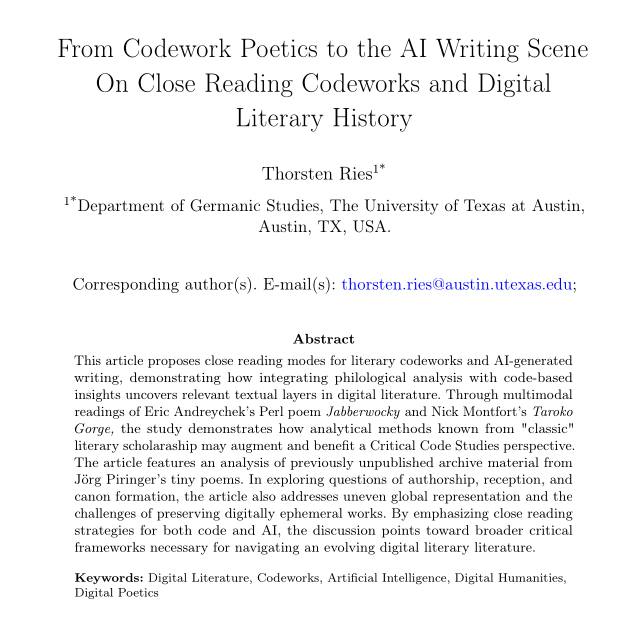
I am happy to share the accepted manuscript version of my recent article “From Codework Poetics to the AI Writing Scene
On Close Reading Codeworks and Digital Literary History”, published 2025 in International Journal of Digital Humanities 7, 357–392 (2025). The published, citable version can be found under the stable DOI at IJDH (Springer): https://doi.org/10.1007/s42803-025-00109-5. ALL RIGHTS RESERVED
Please find the accepted manuscript version here.
This article proposes close reading modes for literary codeworks and AI-generated writing, demonstrating how integrating philological analysis with code-based insights uncovers relevant textual layers in digital literature. Through multimodal readings of Eric Andreychek’s Perl poem Jabberwocky and Nick Montfort’s Taroko Gorge, the study demonstrates how analytical methods known from “classic” literary scholarship may augment and benefit a Critical Code Studies perspective.
This article seeks to reconnect digital literature and CCS reading modes and the close reading / historical contextualization reading modes of philology in a multimodal analytical mode.
The article features an analysis of previously unpublished archive material from Jörg Piringer’s tiny poems. In exploring questions of authorship, reception, and canon formation, the article also addresses uneven global representation and the challenges of preserving digitally ephemeral works.
By emphasizing close reading strategies for both code and AI, the discussion points toward broader critical frameworks necessary for navigating an evolving digital literary literature.
In its AI part, the article addresses a fundamental issue of digital aesthetics in the age of AI that emerges from the code poetry historical, philological close readings of Andreychek, Montfort, Piringer: if the aesthetic “clue” of digital code poetry lies in exposing the algorithmic mechanism and making it traceable, accessible to an algorithmic “empathy” (even in phantastic ways, if the code would never work), then AI models don’t offer this aesthetic device beyond the chatbot GUI and the textual product. GAN art was an important step, where GAN morph images still offered a clear alterity and traces of the AI generation mechanism that was aesthetically interesting, but today’s textual and graphical GenAI products erase the aesthetically productive difference while not offering a direct access to the black box of its generative mechanism. I am arguing, however, that from the philological, forensic analysis side, this generative mechanism may be mostly a black box, but not in every aspect – art some levels, forensic analysis is still possible, and the field is evolving.
Since this article was published, my concerns about the blind spots of the field for non-English digital literature have been addressed and implicitly confirmed by the work of Menon et al, especially the Indian Electronic Literature Anthology vols I, II; and by R. Risam’s work. These are such important steps in the right direction, and we need more.
